
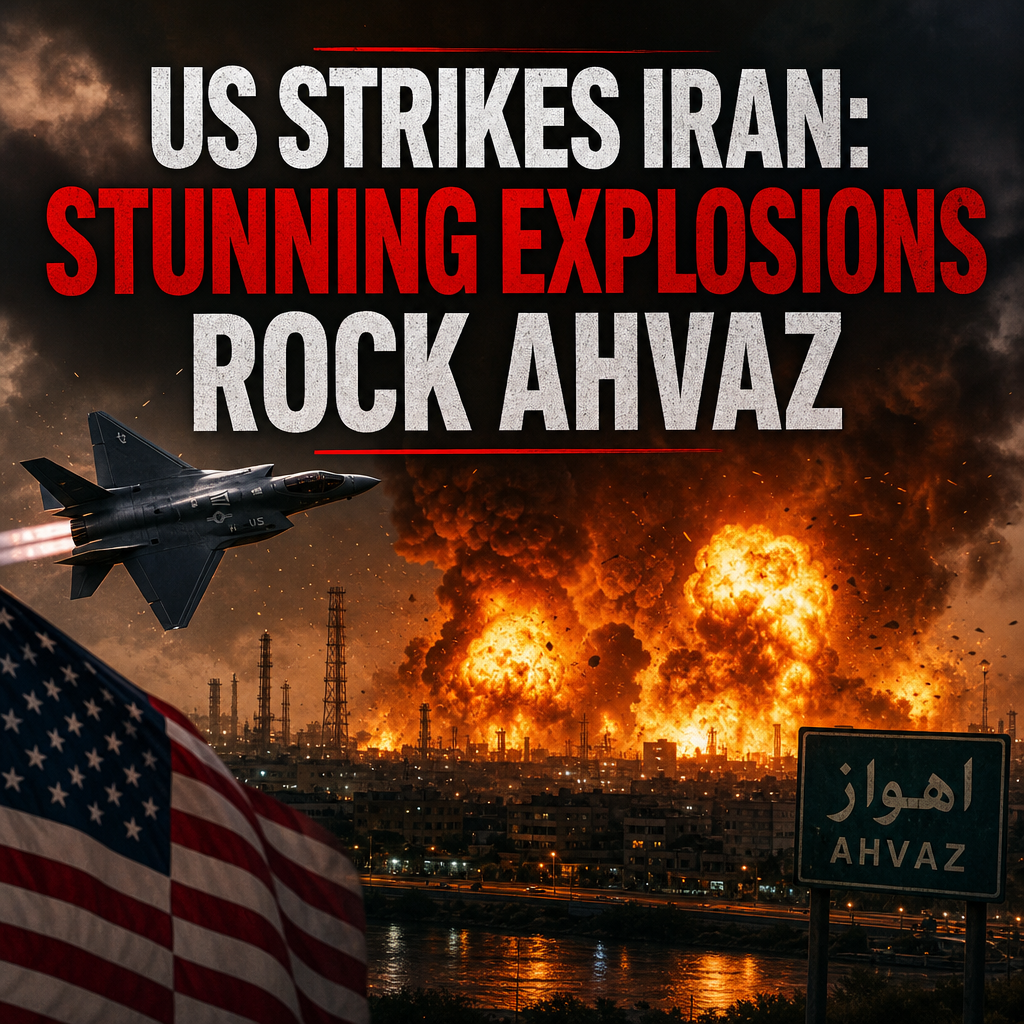
US Strikes Iran: Stunning Explosions Rock Ahvaz


US strikes Iran have once again pushed the Middle East into a dangerous fog of uncertainty, after reports of stunning explosions in and around Ahvaz renewed fears that the long-simmering confrontation between Washington and Tehran could widen further. What makes this moment especially volatile is not just the scale of the reported blasts, but the sharply different interpretations surrounding them: some outlets and officials frame the strikes as a direct military warning, while others see them as part of a broader cycle of retaliation, deterrence, and political signaling.
At the time of reporting, details remain fragmentary. That matters. In conflicts involving Iran, initial claims often arrive before verification, and each side has incentives to shape the narrative. As a result, the most responsible reading is not to rush toward certainty, but to weigh what the reported attack suggests in the wider regional context.



What the reports suggest about US strikes Iran
Ahvaz, a strategically important city in southwestern Iran, sits in a sensitive province with infrastructure, military value, and symbolic weight. Reports of explosions there immediately raise questions about whether the incident was aimed at military facilities, energy assets, or something else entirely. If the strikes were indeed linked to US action or US-aligned operations, the message would likely be about pressure and deterrence rather than outright escalation toward full-scale war.
That distinction is important. In the region’s recent history, cross-border strikes and covert attacks have often been calibrated to stay below the threshold of open conflict while still inflicting damage and making political points. The danger is that such “limited” actions can quickly produce unintended consequences. Iran has repeatedly shown that it can respond asymmetrically through allies, proxy forces, cyber operations, or maritime disruption, which means any strike can reverberate far beyond the original target.




There is also a domestic dimension inside Iran. Government messaging in moments like this typically serves two purposes at once: to reassure the public and to project strength. Even when officials avoid confirming specifics, they tend to frame the country as capable of absorbing and answering any attack. That posture can help preserve legitimacy, but it can also harden positions and narrow room for de-escalation.
Why the regional context matters
The latest reports cannot be separated from a wider pattern of tension involving Iran, the United States, and multiple flashpoints across the Middle East. In recent months, regional conflict has been shaped by overlapping crises: drone and missile exchanges, maritime security concerns, attacks involving allied militias, and the pressure of broader geopolitical rivalry.
From a Western security perspective, strikes aimed at Iranian territory are often justified as responses to perceived threats, including proxy attacks or nuclear-related concerns. From Iran’s perspective, however, such actions are viewed as violations of sovereignty and evidence that Washington and its partners are willing to use force first and diplomacy later. Both views are politically coherent, even if neither fully captures the human cost or the risk of miscalculation.
That is where the reporting from international news outlets becomes especially useful. Al Jazeera’s coverage of the region tends to emphasize the political and civilian consequences of military escalation, including the likelihood that ordinary people will bear the consequences long after the headlines fade. Sky News reporting, by contrast, often places the focus on security implications for Europe, global shipping, energy markets, and allied military coordination. RT, meanwhile, tends to foreground claims that cast US actions as provocative or destabilizing, especially when discussing Russia’s critique of Western policy. Read together, these angles do not cancel each other out; they reveal just how differently the same event is understood across media ecosystems.
The competing narratives around the strikes
There are at least three ways to interpret the reported explosions in Ahvaz:
– A tactical strike intended to send a warning: This view sees the attack as a limited but deliberate demonstration of force, designed to alter Iranian behavior without triggering a wider war.
– A response within a longer cycle of retaliation: Here, the strikes are treated as one move in an ongoing exchange, where each side believes it is answering the other’s previous actions.
– A dangerous escalation with unclear control: This interpretation focuses on the risk that even a supposedly contained attack could provoke a broader reaction, especially if casualties or infrastructure damage are significant.
The truth may contain elements of all three. That is why certainty is hard to come by in the immediate aftermath of such incidents. Conflicting claims, official silence, and strategic messaging can obscure the facts for hours or even days. In the meantime, markets, diplomats, and military planners are left to react to possibility rather than confirmation.
A cautious conclusion
The most grounded conclusion is that the reported strikes in Ahvaz, whether carried out directly by the United States or attributed to actions linked to it, underscore how fragile the current balance has become. The region is already saturated with mistrust, and each new explosion reduces the space for diplomacy.
At the same time, it would be premature to treat the reports as proof of a broader war in the making. These episodes often begin with ambiguity, and the final picture can differ sharply from the first wave of headlines. What is clear, though, is that the risk is not abstract. In a region where military signaling is often mistaken for control, the gap between a calibrated strike and a major escalation can be frighteningly small.
For now, the Ahvaz explosions stand as another reminder that the US-Iran confrontation remains one of the most unstable fault lines in global politics. The immediate facts may still be developing, but the larger lesson is already visible: when force is used in a landscape this combustible, the aftermath can matter as much as the attack itself.


























